
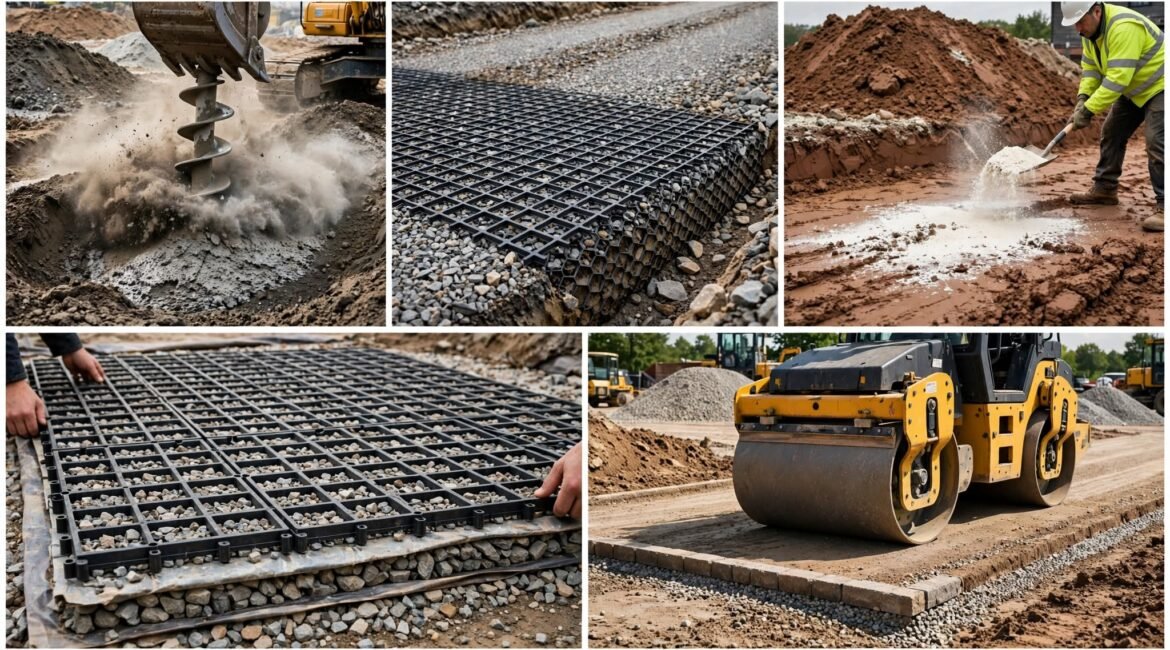
Soil Stabilizers for Driveways do one simple job. Fix the ground below. The pavement above takes care of itself. Most people do it backwards. Concrete goes down first. Cracks show up later. Repair bills follow.
Winter reveals everything. Water sneaks in. Freezes. Expands. Driveway lifts. Same story next year.
Five things work. Done right, they last. Done wrong, money wasted.
Fix the Ground First
This step gets skipped. Every time. Contractors rush. Owners want a finished driveway. Nobody looks underneath. Two winters later, cracks. Then concrete gets blamed. Wrong target.
These stabilizers target the real cause. Weak subgrade cannot hold pavement. Clay swells after rain. Shrinks in drought. That movement never stops. These stabilizers change clay’s habit. No swelling. No shrinking. No cracks.
Sandy soil is a different headache. Particles slide around. Vehicle weight lands. Support vanishes. Pavement above breaks. These solutions lock sand particles together. Shape holds.
Timing has no substitute. Stabilization before paving. Retrofitting later costs triple. These solutions go on bare subgrade. Permanent fix.
The work itself matters too. Excavate soil. Mix stabilizer. Adjust moisture. Compact. Such treatments punish rushing. Hurry means failure.
Weather plays its part. Rain delays everything. Dry spells help. Smart crews watch forecasts. Such treatments work fits around weather windows.
Equipment matters as well. Wrong mixer means poor distribution. Wrong roller means weak density. Proper stabilizers demand the right machines. Rental costs beat failure costs.
Pick the Right Product
Not every product works everywhere. Proper stabilizers come in different formulations. Clay needs one type. Sand needs another. Wrong choice wastes money. No results either.
Cement works on most soils. Hydration creates bonds. Strength builds. Cement-stabilized bases resist driveway cracks.
Lime suits clay best. Chemical reaction cuts swelling. Clay settles down. Driveway stays smooth.
Polymer is another option. Coats particles. Creates adhesion. Works where cement cannot.
Enzymatic products work biologically. Soil properties change permanently. Years of service when applied correctly.
Testing comes first. These methods must match the actual soil. Guessing fails. Lab analysis reveals what sits below. Professional guidance picks the product.
Local conditions matter too. Climate differs. Rainfall differs. Traffic differs. These methods that succeed in one place can fail in another.
Cost enters the picture. Cheap products often disappoint. Premium products cost more upfront. Effective stabilizers value shows over years. Short-term thinking costs more.
Storage needs attention. Liquid products need temperature control. Dry products need moisture protection. Effective stabilizers stored wrong lose effectiveness. Storage rules matter.
Get the Depth Right
Surface-level work never lasts. Problem soil sits below. Movement continues. Stabilization projects must reach full depth.
Cars are light. Trucks are heavy. RVs and boats heavier still. Stabilization projects depth follows usage.
Clay makes depth critical. Active zone runs several feet down. Moisture changes happen throughout. Soil Stabilizers for Driveways must cover the entire active layer.
Soil borings tell the truth. Testing reveals depth. Soil Stabilizers for Driveways at correct depth deliver reliable support.
Shallow depth creates a crust. Load lands. Crust breaks. Everything below shifts. Soil Stabilizers for Driveways at shallow depth waste money and fail.
Excess depth wastes too. Digging deeper than needed. More material. More time. Soil Stabilizers for Driveways need balance. Not shallow. Not deep. Correct.
Engineering advice helps. Geotechnical report guides decisions. Soil Stabilizers for Driveways depth without data is gambling. Data first. Decision second.
Depth checks happen during work. Measure as digging proceeds. Stop at the right point. Soil Stabilizers for Driveways projects need supervision. Sloppy depth means sloppy results.
Control Moisture
Moisture decides everything. Soil Stabilizers for Driveways need the right water. Too dry means no reaction. Too wet means dilution.
Cement needs water for hydration. Low water means no strength. Cement sits inert. Soil Stabilizers for Driveways cement projects demand moisture management.
Lime needs water too. Reaction requires it. Dry conditions leave lime unreacted. Stabilizer application must account for this.
Weather ruins plans. Rain adds water. Drought removes it. Contractors adjust constantly. Soil Stabilizers for Driveways projects stay flexible.
Testing reveals moisture levels. Adjustments follow. Then application. Soil Stabilizers for Driveways without testing invite failure.
Water trucks add moisture when dry. Disc harrows dry wet soil. Active management. Soil Stabilizers for Driveways demand constant attention.
Timing within the day matters. Morning moisture differs from afternoon. Stabilization crews watch conditions hour by hour. Small changes add up.
Compact Properly
Compaction builds structure. Without it, Soil Stabilizers for Driveways never reach potential. Particles need pressure.
Small driveways use plate compactors. Large ones use rollers. Proper compaction needs the right tool.
Moisture decides compaction quality. Specific moisture gives best results. Stabilizer application needs balance.
One pass is not enough. Multiple passes required. Soil Stabilizers for Driveways projects demand patience.
Density testing confirms quality. Soil Stabilizers for Driveways performance depends on density. Testing verifies results.
Over-compaction damages too. Too many passes break soil structure. Soil Stabilizers for Driveways need correct pressure. Correct passes. Avoid over-compaction.
Edge compaction gets forgotten. Driveway edges crumble first. Soil Stabilizers for Driveways crews must compact edges properly. Edges hold the whole surface together.
Soil Stabilizers for Driveways fix the root cause. Five fixes above. Ground first. Right product. Right depth. Moisture control. Proper compaction.
Money gets saved. Soil Stabilizers for Driveways pay for themselves. Driveway stays smooth. Cracks never form. Value holds.
Contractors who understand deliver better results. Soil Stabilizers for Driveways are proven technology. Follow procedure. Success follows.
Every project teaches something. Soil Stabilizers for Driveways keep improving. New products. New techniques.
Every driveway project needs stabilization. Benefits exceed costs. Soil Stabilizers for Driveways last decades.
Modern products beat older ones. Techniques keep improving. Soil Stabilizers for Driveways reward understanding. Old thinking fails. New approach wins.
Homeowners save thousands over time. Soil Stabilizers for Driveways prevent repeat repairs. One proper installation. Years of service. No crack patching. No resurfacing bills.


[…] TYPHON Mini Excavators change the conversation when you walk into any equipment yard. The talk is always about the big names. The yellow machines. The orange machines. Buyers pay a premium for the logo on the side. Look at the sales data on eBay. A different story shows up. TYPHON Mini Excavators are moving units faster than the competition. It outsells machines that cost three times as much. […]