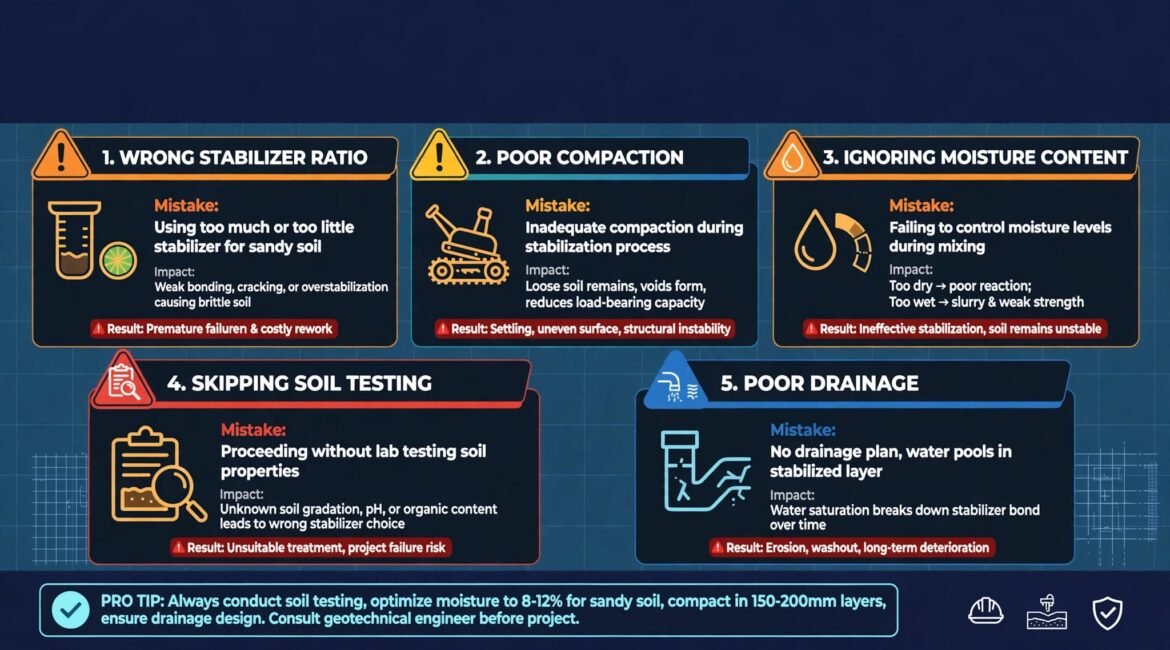
Soil Stabilizers for Sandy Soil can make the difference between a successful project and a complete disaster. Sandy ground presents unique challenges that catch many builders off guard. The particles shift constantly. Water drains too quickly. Loads sink without warning. What looks like solid ground turns into a nightmare once construction begins.
Soil Stabilizers for Sandy Soil solve these problems when applied correctly. But mistakes happen frequently. Contractors unfamiliar with sandy conditions make costly errors. Property owners attempt DIY solutions that fail spectacularly. The five critical mistakes outlined below ruin projects regularly.
Understanding these mistakes prevents expensive failures. Soil Stabilizers for Sandy Soil require different approaches than other soil types. What works on clay fails miserably on sand. What succeeds on loam produces disasters on sandy ground. Recognizing these differences makes all the difference.
Choosing the Wrong Type of Soil Stabilizers for Sandy Soil
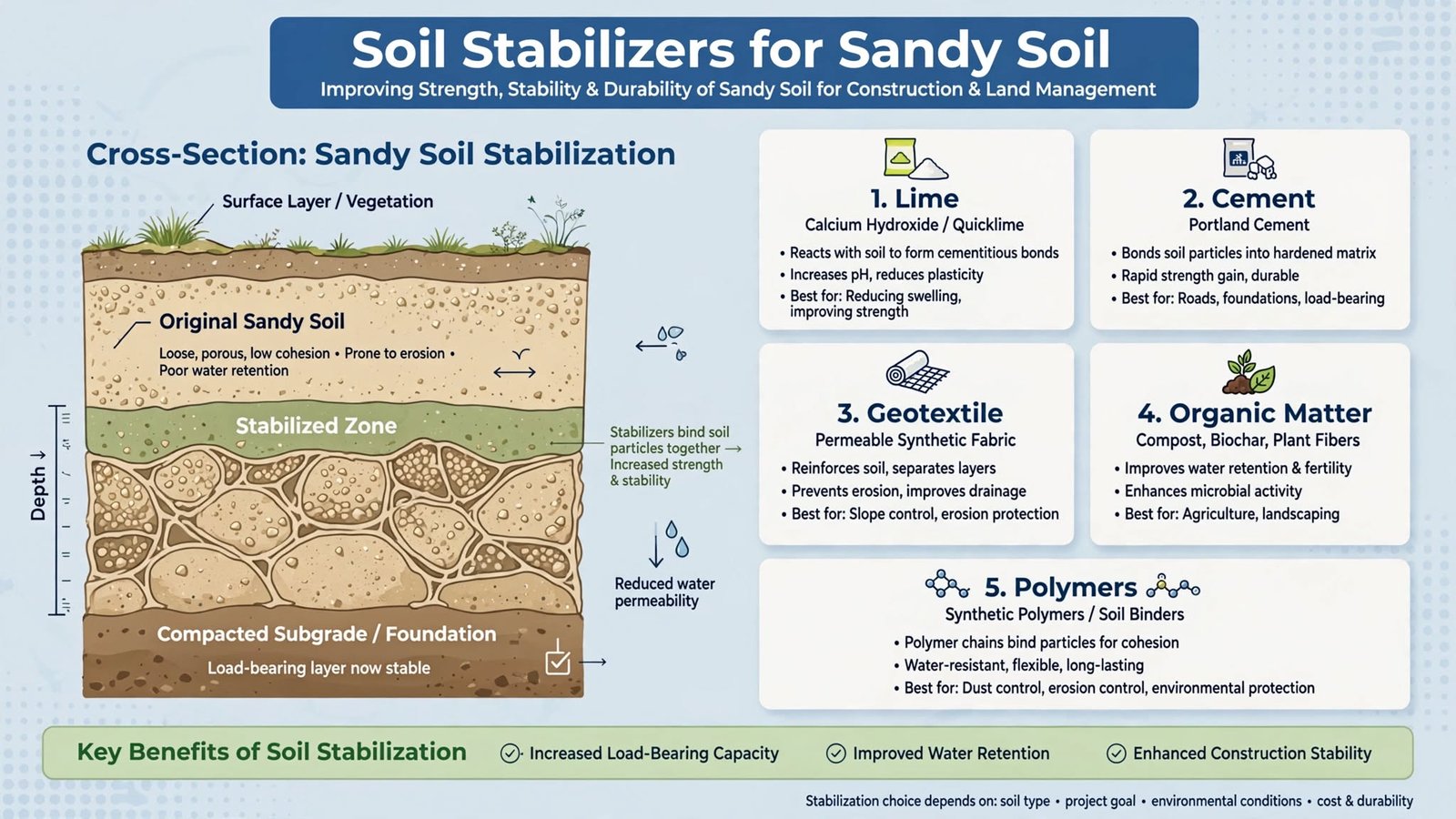
Soil Stabilizers for Sandy Soil come in several formulations, but not all work effectively. Sandy soils lack the fine particles that help bind other soil types together. The large particle size creates unique challenges that require specific stabilizer chemistry.
Cement-based stabilizers perform well in most conditions. The cement fills the voids between sand particles and creates strong bonds. Properly applied cement stabilization transforms loose sand into material resembling concrete. Strength develops quickly and lasts for decades.
Polymer stabilizers offer another effective option. These synthetic products coat sand particles and create adhesion between them. The polymer chains bridge the gaps that cement fills. Polymer stabilization works particularly well when cement proves impractical.
Lime-based products rarely succeed. Lime needs clay particles to react with. Sandy soils contain little or no clay. Applying lime to pure sand wastes money and produces no benefit. This mistake happens constantly.
Enzymatic treatments also struggle in sandy conditions. These biological products work through clay modification. Without clay present, enzymes have nothing to modify. The treatment fails completely.
Selecting the wrong stabilizer type guarantees failure. Soil Stabilizers for Sandy Soil must match the specific sand characteristics. Laboratory testing identifies the right approach. Skipping this step invites disaster.
Ignoring Proper Moisture Control
Soil Stabilizers for Sandy Soil require precise moisture management during application. Sandy soils drain rapidly, creating unique challenges. Water disappears before stabilizers can react properly. The application dries out before achieving effectiveness.
Cement-based treatments need adequate water for hydration. Sandy soils absorb water quickly, leaving insufficient moisture for cement reactions. Additional water must be added during mixing. The moisture content requires constant monitoring throughout application.
Polymer solutions also demand proper moisture conditions. These products need water to disperse and coat particles evenly. Dry sand repels polymer solutions. The stabilizer beads up instead of spreading. Proper wetting ensures uniform coverage.
Soil Stabilizers for Sandy Soil application in hot weather proves especially challenging. High temperatures accelerate evaporation. The moisture disappears before stabilizers penetrate. Early morning or evening application avoids this problem.
Over-watering creates different issues with these stabilization methods. Excess water pools on the surface since sand drains slowly when saturated. The pooled water dilutes stabilizers and carries them away. Finding the right moisture balance requires experience and attention.
Skipping Proper Compaction
Soil Stabilizers for Sandy Soil absolutely require proper compaction to achieve strength. Sandy particles need mechanical pressure to lock together. Without compaction, stabilizers cannot create the dense structure needed for load support.
Compaction equipment selection matters greatly for these stabilization projects. Vibratory rollers work best on sandy materials. The vibration settles particles into dense arrangements. Static rollers prove less effective on sand.
Compaction moisture content affects results with these treatments. Sand compacts best at specific moisture levels. Too dry prevents particle rearrangement. Too wet causes instability. Finding the optimal moisture requires testing.
Soil Stabilizers for Sandy Soil compaction must extend through the full treatment depth. Surface compaction alone leaves loose material below. The untreated sand shifts under loads. Proper depth ensures uniform support.
Multiple compaction passes may be needed with these methods. Single passes often prove insufficient. Repeated passes achieve the density required for structural support. Contractors sometimes rush this step and pay the price later.
Underestimating Application Depth Requirements
Soil Stabilizers for Sandy Soil must penetrate to adequate depth for proper support. Sandy soils often require deeper treatment than other soil types. The loose structure extends further down. Shallow treatment leaves problematic material below.
Foundation support with such stabilizers demands treatment to significant depths. Building loads transfer through the stabilized layer to underlying soils. Inadequate depth allows settlement and structural damage.
Road construction using these methods requires depth based on traffic loads. Heavy trucks need deeper stabilization than passenger vehicles. The treatment depth must match the loading conditions.
Soil Stabilizers for Sandy Soil applied too shallow create a crust effect. The thin stabilized layer cracks under load. Sandy material below shifts and settles. The surface breaks apart. Proper depth prevents this failure mode.
Determining adequate depth for Soil Stabilizers for Sandy Soil requires geotechnical evaluation. Soil borings reveal the extent of sandy conditions. Engineering analysis calculates required treatment depth. Skipping this step risks inadequate stabilization.
Neglecting Long-Term Performance Monitoring
Soil Stabilizers for Sandy Soil require ongoing attention after application. Sandy conditions can change over time. Water movement alters soil structure. Environmental factors affect stabilizer performance.
Soil Stabilizers for Sandy Soil performance should be verified periodically. Testing confirms continued effectiveness. Samples can be analyzed for stabilizer content. Strength testing reveals any degradation.
Environmental changes affect the stabilized soil over time. Drought conditions alter sand structure. Flooding introduces water that affects stabilizers. Temperature extremes stress stabilized materials. These factors require monitoring.
Maintenance requirements vary by application. Some installations need periodic reapplication. Others require only monitoring. Understanding maintenance needs prevents unexpected problems.
Soil Stabilizers for Sandy Soil failures often occur gradually. Small problems develop into major issues. Regular inspections detect these problems early. Early intervention prevents extensive damage.
Documentation helps track Soil Stabilizers for Sandy Soil performance. Records of application details aid future decisions. Photos document initial conditions. Testing records show changes over time.
Soil Stabilizers for Sandy Soil work effectively when applied correctly. The five mistakes above ruin projects regularly. Choosing wrong stabilizer types wastes money. Ignoring moisture control prevents proper reactions. Skipping compaction leaves loose material. Underestimating depth creates settlement problems. Neglecting monitoring allows failures to develop.
Soil Stabilizers for Sandy Soil require careful selection based on testing. Laboratory analysis identifies appropriate products. Professional guidance ensures correct choices.
These products demand proper application techniques. Moisture control enables reactions. Thorough compaction achieves density. Adequate depth provides support.
Soil Stabilizers for Sandy Soil need ongoing attention. Regular inspections detect problems early. Periodic testing verifies effectiveness. Maintenance programs protect investments.
Soil Stabilizers for Sandy Soil have solved countless construction challenges. Proper use saves property owners enormous repair costs. Understanding the mistakes allows avoidance of common problems.
Property owners building on sandy ground should prioritize stabilization. The investment protects structures for decades. The five critical mistakes can be avoided with proper education. Soil Stabilizers for Sandy Soil work effectively when applied correctly.